
Part III — Documentation & Customs
Export & Import Procedures
How a forwarder actually runs a shipment end to end — quoting, booking, vessel selection, documents and delivery — under each Incoterm, with worked transit-time examples.
This is the operational heart of forwarding. Everything in the earlier chapters — Incoterms, rates, documents — comes together here, in the actual sequence of running a shipment. NAFL devotes more pages to this than to any other topic, because it is where a forwarder earns their reputation: not just moving a box, but mastering the movement rather than putting up with it.
Before you quote: the basic facts
NAFL lists the factors a forwarder must weigh before recommending a method of transport or routing:
- Nature of the goods — general cargo, or special (perishable, hazardous, live animals, bulk, out-of-gauge)?
- Voyage — direct, or with transhipment/transfer?
- Time element — how urgent is it?
- Cost — cheapest, quickest, or safest?
- Safety / security — containerised or conventional?
It is obvious that 100 tonnes goes by sea. It is not obvious for 150–200 kg. Because sea is charged on measurement and air on weight (the 1:6 ratio, Chapter 3), a bulky-but-light consignment can cost almost the same by air — and arrive far faster and more safely. For small, bulky, high-value or urgent cargo (pharmaceuticals, scientific apparatus), always compare the air rate. A well-run forwarder keeps air and sea desks in close contact; sending by sea something that would cost no more by air is, in NAFL’s word, “incompetent.”
The quotation
To quote, the forwarder needs: type of goods (for the rate category), volume and weight (volume for sea, weight for inland), value (for insurance), whether collection/delivery and export packing/marking are included, the customer’s preferred mode, and what clearance/documents are required. NAFL’s rules for a sound quote:
- Offer two or more options where alternative routings exist.
- Cover your own costs — B/L fees, certificates, clearance, your intervention fee. Novices forget these.
- Always state validity — “valid as per present freight and exchange rates; any variation, up or down, for the account of the goods.” Quotations should never be open-ended.
- Decide the format your client wants: a single lump sum, or a fully itemised breakdown.
Running a shipment under CFR / CIF (you act for the seller/exporter)
When the contract is CFR or CIF, the exporter controls the transport. The forwarder will:
- Check for a documentary credit and whether its terms can be met.
- Obtain export-clearance documents (invoice, packing list, DG declaration where needed).
- Fix the date of availability and place of collection.
- Book with the carrier, allowing time from warehouse to delivery alongside, plus export clearance, before the vessel closes.
- Coordinate delivery to the stevedores, export clearance and delivery alongside; prepare and lodge the B/L after confirming the goods were received in good order and tally with the documents.
- Cover insurance if required.
- Pay the freight, retrieve the B/Ls, distribute documents per the principal’s instructions, and issue the invoice.
Running a shipment under EXW / FOB / FAS (you act for the buyer)
Here the forwarder is usually acting on instructions from the buyer (directly, or via the buyer’s agent abroad), and represents the buyer’s interest — not the seller’s. The mechanics of calling cargo forward are similar, but the documents differ: the B/Ls are typically made out “freight collect,” and the forwarder transmits documents to the agent under an instructions waybill. NAFL’s standing rule for clarity: state explicitly on every advice “insurance is / is not covered by us,” to remove any doubt.
A worked example — the Bayer / Pharmimport shipment
NAFL teaches the whole flow through one case, worth following because it shows how the pieces connect:
Pharmimport, Dubai imports 4 tonnes of pharmaceuticals from Bayer, Leverkusen, terms FOB Hamburg. A documentary credit requires shipment by 31 August; goods ready ~14 August. You must cover insurance. The B/L is to order of Deutsche Bank, notify Pharmimport, no transhipment.
- Contact your Hamburg agent immediately with Bayer’s reference, the goods, the FOB terms, the delivery date and the L/C expiry — asking for a direct sailing before end-August, with rates and fees.
- The agent replies with three sailings: a conference vessel 16/8, another 23/8, a non-conference 29/8. You eliminate the 29/8 sailing as dangerously close to the credit expiry — a 2–3 day delay would “create havoc” with the L/C.
- You quote the client all-in (Hamburg B/L charges, freight + BAF + CAF, Dubai insurance/clearance/delivery, duties), always noting that rate/surcharge/duty/exchange fluctuations are for the goods.
- You issue the instructions waybill to your agent and advise the client of cost and timing.
- You cover insurance (“all risks, including wetting by rain/sea water, pilferage, W & SRCC” for pharmaceuticals).
- To save time, customs entry forms are prepared in advance, completed on the vessel’s arrival — normal good practice in the UAE.
The lesson NAFL draws: even on a one-week voyage, the documents (B/L moving Bayer → Deutsche Bank → Dubai bank → Pharmimport → you) can take ~20 days, so cargo may sit in store at the port awaiting paperwork. Plan for the document cycle, not just the sailing.
Selecting the vessel
The choice of vessel turns on technical then commercial factors:
- Technical: the type and quantity of cargo. Bulk volumes may require chartering a specialised ship (ore/bulk carrier, tanker/VLCC, reefer, ro-ro, combi). Break-bulk and heavy-lift need a vessel with suitable gear — or a well-equipped port (e.g. Dubai’s port facilities) where the ship need not carry its own cranes.
- Commercial: sailing dates vs cargo readiness; voyage duration (a longer wait for a faster/direct vessel may beat an early sailing with a 30-day transhipment); which transhipment port; and which line to use.
NAFL describes the market in terms of “conference” lines (carriers agreeing reduced, regular rates) versus “outsiders” / “flags of convenience” (Panama, Liberia, Cyprus) running cheaper independent services. That world has changed. Shipping conferences were abolished in the EU in 2008, and the market consolidated into a handful of global carrier alliances (2M, Ocean Alliance, THE Alliance) and mega-carriers. The underlying judgement NAFL teaches — weigh rate, transit time, reliability and safety, don’t just take the cheapest — is unchanged. (Chapter 26 covers today’s alliance structure.)
Calculating transit time — worked cases
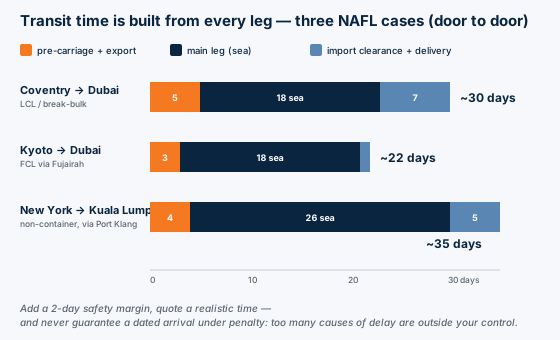
NAFL has the forwarder build transit time from all legs, not just the sea voyage. Three of its worked cases (warehouse-to-warehouse):
| Routing | Pre-carriage + export | Main leg | Import + delivery | Total |
|---|---|---|---|---|
| Coventry → Dubai (LCL/break-bulk) | 3 + 2 days | 18 days sea | 6 + 1 days | ~30 days |
| Kyoto → Dubai (FCL via Fujairah) | 3 days | 17 days + 1 | 1 day | ~22 days |
| New York → Kuala Lumpur (non-container, via Port Klang) | 4 days | 26 days | 3 + 2 days | ~35 days |
Always add a 2-day safety margin, quote a realistic transit time — and never guarantee a firm arrival date with penalty for delay. Too many causes of delay are outside the forwarder’s control, and the profit margin is too thin to carry that risk; such a commitment is a management decision only.
The export-file checklist
NAFL’s summary of what a forwarder pins down to open an export file: nature/packing/weight/dimensions of goods · contract terms (FOB/CFR/CIF…) · how the B/Ls are made out and distributed · documentary credit or not · insurance (and on what conditions) · the documents needed (invoice, packing list, export/exchange licences, certificates) · who the principal is (vendor, buyer, or your own agent abroad) · and to whom you bill.
This chapter is the WorldZone operator’s day: take the enquiry, establish the Incoterm and the facts, quote all-in with validity, book, coordinate documents and clearance through the destination office, and deliver — switching between acting for the seller (CFR/CIF) or the buyer (EXW/FOB) depending on the contract. WorldZone’s seven-country network is exactly the “reliable agent at the other end” NAFL says every forwarder must have: the Dubai and India offices acting as each other’s destination agent under one instruction is what makes a shipment seamless instead of a relay of strangers.
What to take from this chapter
- Establish the facts and the Incoterm before quoting; compare sea vs air even for small cargo.
- Quote all-in, with validity — never open-ended; cover your own costs.
- Know whether you act for the seller (CFR/CIF) or buyer (EXW/FOB) — it changes the documents and freight terms.
- Build transit time from every leg + a safety margin; never guarantee a dated arrival under penalty.
- Plan for the document cycle, which can outlast the voyage itself.