
Part V — Air & Multimodal
Multimodal & Sea-Air Operations
Moving cargo under one contract across several modes — rail/road, sea/road, LASH/SEABEE — the forwarder as multimodal operator, and the step-by-step sea-air transhipment.
Almost any international shipment uses more than one mode — sea then road, or rail then sea. What makes transport multimodal in the modern sense is doing it without breaking bulk, under one transport document, with the goods staying in the same container or trailer from origin to destination. NAFL calls this the result of the “container revolution,” and it is where forwarders create some of their most valuable services.
Multimodal (also intermodal / combined) transport is the carriage of a loaded freight unit — container, trailer or vehicle — under a single transport document using more than one mode of transport (e.g. sea + rail, sea + road, sea + air), without the cargo itself being unpacked and repacked between modes.
The multimodal combinations
NAFL works through the main mode combinations:
- Rail / Road — the oldest combination. Vehicles, trailers or containers ride on flat rail wagons for the long middle leg; trucks handle only the first and last legs. Faster (trains run day and night), cheaper, less wear on vehicles. TOFC = Trailer On Flat Car; COFC = Container On Flat Car; in the US, higher bridges allow double-stack trains (two containers high).
- Sea / Road (Ro-Ro) — “horizontal” handling: wheeled cargo driven on and off via ramps (Chapter 12). No lifting gear needed, so heavy machinery on trailers loads fast.
- Lo-Lo (Lift on / Lift off) — the “vertical” handling of containers by crane — the standard container operation.
- Waterways / Sea / Waterways (LASH & SEABEE) — barge-carrying ships:
- LASH (Lighter Aboard Ship) — barges ~20 m long, ~350–380 t payload, lifted aboard by the ship’s own gantry and stacked like containers; floated to/from shore or up-river.
- SEABEE — larger barges, ~30 m, ~800 t, loaded via a stern elevator or float-in. Valuable where ports are congested (barges act as floating warehouses) and for inland-waterway networks (e.g. Rotterdam/Rhine, Mississippi).
The forwarder as Multimodal Transport Operator
Multimodal transport is a major opportunity for forwarders because it lets them offer door-to-door service and a single through rate. NAFL distinguishes two roles:
- MTO (Multimodal Transport Operator) — the forwarder takes on carrier responsibility for the whole journey, issuing their own through document. Example: a forwarder runs a Frankfurt→Dubai consolidation, trucks the boxes to Hamburg on their own vehicles, then takes a sea B/L — acting as MTO.
- Multimodal user — the forwarder buys a carrier’s through B/L and lets the carrier’s network handle the onward legs — the forwarder is the user of the multimodal service, not the operator.
The FIATA combined transport bill of lading (FBL) is an agent’s through B/L that places the forwarder in the position of a carrier for a multimodal movement. It is widely accepted under letters of credit where a “carrier-type” document is required — the document that lets a forwarder act as MTO. (Recall from Chapter 4 that FCA is the Incoterm designed for multimodal hand-over.)
A practical obstacle NAFL flags: customs clearance at the port of unloading. If a container can’t move inland under bond, it must be emptied at the arrival port — which erodes the door-to-door advantage for inland consignees. (Modern bonded-transit and free-zone systems, Chapter 10, have eased this considerably.)
Sea-Air operations — the middle path
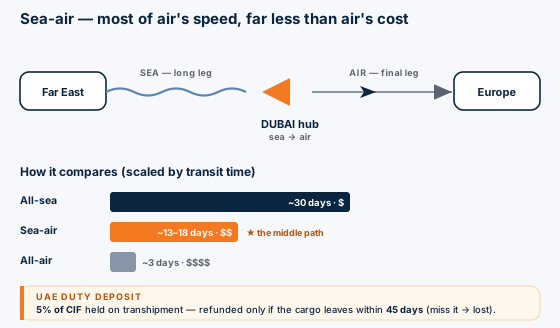
A combination that captures much of air’s speed at much less than air’s cost by shipping the long leg by sea, then flying the final leg.
Sea-Air moves cargo by sea for the long-haul leg to a transhipment hub, then by air for the final leg — far faster than all-sea, far cheaper than all-air. NAFL’s example: Far East → Europe via Dubai as the hub in ~13–18 days, versus ~27–32 days all-sea — using Dubai/Sharjah’s proximity of seaport and airport.
It demands precise coordination and skilled staff — mistakes are costly (miss the booked flight after a late ship and cargo is stranded, with customs/duty complications).
The sea-air transhipment, step by step
NAFL lays out the operation as a sequence. This is the operational checklist for a hub like Dubai:
- Pre-alert from the origin agent — shipment intended on a particular vessel.
- Final alert — once the vessel has sailed, confirming it’s aboard with the sailing date.
- Documents arrive (Master/Ocean B/L, CTD, invoice, packing list).
- Prepare documents to obtain the Delivery Order (D/O) from the line before the vessel arrives.
- Prepare a Transhipment Bill of Entry (B/E); get the ship’s manifest to Customs.
- Assemble the full customs set (copies of B/L, invoice, packing list + D/O + B/E).
- Customs stamps/approves the B/E for transhipment.
- On arrival, arrange trucks; the line releases the containers against the B/E.
- Customs applies their own seal (cargo is transhipping, not entering the UAE).
- Containers trucked to the airport — under customs bond the whole way.
- At the airport, Customs breaks the seal; the forwarder de-stuffs the container.
- Tally and inspect every piece, recording condition (the forwarder may be liable for transhipment damage — make reservations for any pre-existing damage).
- Label to the airline’s requirements (destination, piece count, bar codes).
- Process the Air Waybill through customs (often prepared by the airport handling agent, e.g. DNATA in Dubai).
- Execute the AWB (copies to airline, with shipment, and on file).
- After departure, submit an exit/entry (E/E) certificate with AWB and airline manifest.
- Customs returns the approved E/E, confirming the cargo entered and left.
- Submit the E/E to seaport customs to refund the duty deposit.
- Send a pre-alert to the destination agent.
- Arrange onward delivery to the final consignee.
For transhipment cargo the UAE Customs takes a duty deposit of 5% of CIF value, refunded only once the cargo leaves the country within 45 days. Miss the deadline and the deposit is lost — and on a multi-shipment vessel this can be a very large sum (NAFL cites figures up to ~US$125,000). Speed and accuracy in the steps above protect real money.
LASH/SEABEE barge-ships have largely faded, but the multimodal principle is now the backbone of global logistics, governed by mature rules (the FIATA FBL, UN/MMT conventions) and increasingly by electronic through-documents. Sea-air remains a live, competitive product — and Dubai is still one of the world’s premier sea-air hubs, exactly as NAFL describes. Bonded inland transit and free zones have largely solved the clearance obstacle NAFL flagged.
Multimodal is implicit in most of WorldZone’s core services — almost every shipment combines sea or air with inland haulage (Chapter 24). The MTO-vs-user distinction decides liability and documentation on a given move. And sea-air through Dubai is a genuinely WorldZone-shaped product: the network’s UAE hub plus India and GCC offices is exactly the structure that makes a Far-East→GCC or Europe sea-air routing work — and the 5%/45-day duty-deposit rule is real cash an operator must manage, not a footnote.
What to take from this chapter
- Multimodal = one freight unit, one document, several modes, no breaking bulk (TOFC/COFC, ro-ro, Lo-Lo).
- The forwarder can act as MTO (carrier responsibility, FIATA FBL) or as a user of a carrier’s through service.
- Sea-air buys most of air’s speed at far less cost — Dubai is a prime hub — but needs precise coordination.
- Master the transhipment sequence and the 5% / 45-day duty deposit — missing the deadline forfeits real money.