
Part VIII — WorldZone in Practice
The Industries We Serve
The customer industries behind WorldZone's traffic — construction, oil & gas, manufacturing, retail/FMCG, project & break-bulk, and fellow forwarders — and the cargo each one moves.
The cargo-mix chapter (Chapter 30) looked at what moves; this chapter looks at who it moves for. WorldZone organises its market around a set of customer industries, each with its own cargo, urgency and documentation pattern. Knowing which industry an enquiry belongs to tells an operator, almost immediately, what the shipment will need.
Construction & Infrastructure
The Gulf is a permanent construction site, and the cargo reflects it:
- Heavy equipment delivered to site — excavators, loaders, cranes, generators (often by RoRo, Chapter 15, or flat-rack/break-bulk, Chapter 14).
- Steel and structural materials by ocean freight — rebar, beams, plate, fabricated sections (dense, weight-charged cargo, Chapter 3).
- Project planning and execution for whole-site deliveries — sequencing many shipments to a build programme (Chapter 14).
Oil & Gas
A demanding, safety-critical vertical where WorldZone has specific capability:
- Oilfield equipment and machinery — drilling parts, valves, wellhead and pipeline components, often oversized.
- Hazardous goods (DG) handling by sea and air — chemicals, gases and flammables under IMDG/IATA discipline (Chapter 21).
- Offshore equipment logistics — supplying rigs and offshore facilities, where timing and the right vessel/equipment are everything.
This vertical is where project cargo, dangerous goods and chartering (Chapters 14, 21, 18) most often come together on one job.
Industrial & Manufacturing
The classic forwarding relationship — keeping a factory supplied and its output moving:
- Raw-material import from Asia, Europe and the Americas (feeding the manufacturing line).
- Finished-goods export, FCL and LCL (Chapter 13).
- Vendor consolidation and purchase-order (PO) management — collecting cargo from several suppliers against a buyer’s POs and consolidating it into efficient shipments. This is buyer’s consolidation: a managed service beyond simple groupage, where WorldZone coordinates many vendors to one buyer’s instructions.
Trading & Re-export
The archetypal UAE customer, and the reason the country exists as a logistics hub. These are traders whose core business is import-to-re-export: they buy from the source country where goods are produced (China, India and the like), stage the stock in the UAE, and re-export it to surrounding countries where they have found buyers — the GCC, Africa and the wider region. For this customer WorldZone is more than a carrier; it is the holding and distribution point between purchase and sale:
- Bonded / free-zone warehousing — the stock sits duty-suspended while the trader lines up buyers, so duty never attaches to goods that move straight back out (Chapters 10 and 19).
- Re-export forwarding — onward sea/air shipment to the end buyer’s country, with the duty-deposit refunded because the cargo never entered the local market (Chapter 20).
- Local clearance and last-mile delivery — when part of the consignment is sold inside the UAE, WorldZone clears it into the market (duty now payable) and delivers it to the trader’s local buyer.
A single shipment often splits across both exits — some re-exported, some cleared and delivered locally — which is why this customer values a forwarder who runs storage, customs and delivery as one service, not three vendors.
Retail & FMCG
High-volume, time-sensitive consumer goods (Chapter 30’s FMCG mix):
- Regular LCL consolidation from Asia, India and Europe — frequent, scheduled groupage boxes (Chapter 13).
- Temperature-sensitive and cold-chain logistics — see the cold-chain box below.
- Fast-moving consumer-goods distribution across the GCC.
Project & Break-Bulk Cargo
The heavy, the huge and the awkward (Chapter 14), increasingly including the energy transition:
- Power generation and transformer transport — large, heavy, high-value units needing engineered handling.
- Renewable energy — wind-turbine blades (extremely long out-of-gauge units) and solar panels (high-volume, fragile).
- Steel fabrication and structural components for major projects.
Freight & 3PL Partners
WorldZone also serves other forwarders and logistics providers, not just shippers:
- Co-loading and LCL groupage partnerships — buying space in, or selling space from, another forwarder’s consolidation (Chapter 13), pooling cargo while respecting each other’s clients.
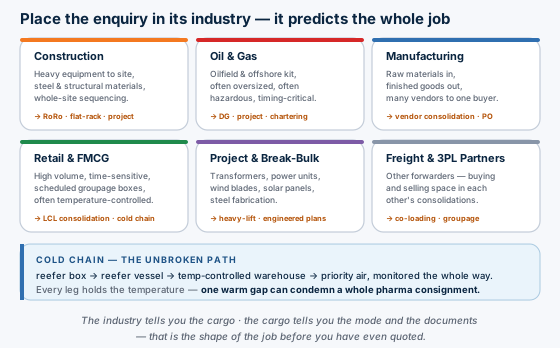
A cold chain is an unbroken temperature-controlled path from origin to destination, for cargo that spoils or loses value if it warms (or freezes) — pharmaceuticals, perishable FMCG, food. It joins up the tools from earlier chapters: reefer containers (Chapter 11), reefer vessels (Chapter 12), temperature-controlled warehousing (Chapter 23) and, for the most urgent or high-value pharma, air / AOG-style priority (Chapter 19). The discipline is continuity — every leg, including the wait on the quay and in the warehouse, must hold the set temperature, with monitoring throughout. A single warm gap can condemn an entire pharmaceutical consignment.
When an enquiry lands, place it in its industry first — it front-loads the right questions. Oil & gas? expect DG, project pieces, maybe chartering. Construction? heavy equipment, steel, RoRo, project sequencing. Retail/FMCG? LCL consolidation and possibly cold chain. Manufacturing? vendor consolidation and PO management. Another forwarder? co-loading. The industry tells you the cargo, the cargo tells you the mode and the documents — and that is the whole shape of the job before you’ve even quoted.
What to take from this chapter
- WorldZone organises its market around six industries: construction, oil & gas, manufacturing, retail/FMCG, project & break-bulk, and freight/3PL partners.
- Each industry has a signature cargo and need — DG/project (oil & gas), heavy equipment/steel (construction), vendor consolidation (manufacturing), cold chain (FMCG/pharma).
- Cold chain is an unbroken temperature path tying together reefer boxes, reefer vessels, temp-controlled warehousing and priority air.
- Identify the industry first on any enquiry — it predicts the cargo, the mode and the documents.