
Part IV — Ocean Freight
FCL, LCL, Consolidation & Groupage
How cargo is sold by the box or by the cubic metre — full containers, shared containers, and the consolidation business where forwarders make their best margin.
Not every shipment fills a container. The way a forwarder handles the gap between “a full box” and “a few cartons” is one of the most commercially important skills in the trade — and, as NAFL puts it plainly, “it is certainly with consolidation that forwarders can best earn their living.”
FCL vs LCL
- FCL — Full Container Load: one shipper’s cargo fills (or is booked as) an entire container. Priced per container. The box is stuffed at origin and ideally not opened until the consignee’s premises.
- LCL — Less than Container Load: a shipment too small to justify a whole container. The forwarder combines it with other shippers’ cargo in a shared box. Priced per CBM or per 1,000 kg, whichever is greater (the W/M rule, Chapter 3).
The choice is mostly about volume and economics: enough cargo to fill or nearly fill a box → FCL; a part-load → LCL. FCL also means fewer handlings (less risk of damage and pilferage), which can justify booking a full box even when not completely full.
Consolidation and groupage — the forwarder’s craft
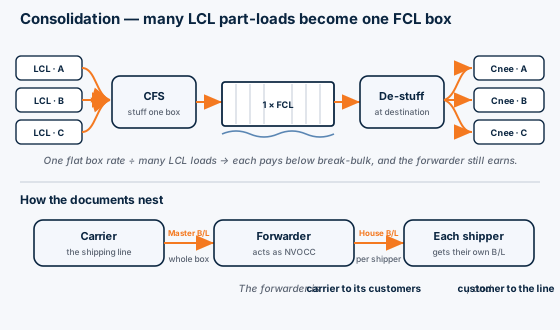
Consolidation (also called groupage) is the practice of a forwarder combining several smaller LCL consignments — from different shippers — into one full container, which is shipped as a single FCL unit and broken down (de-consolidated) at destination for delivery to the individual consignees.
Why it is the forwarder’s best business
NAFL spells out the economics: the forwarder negotiates a flat rate for the box from the carrier, then divides that cost among the LCL customers who entrusted their cargo. Because the box rate is keen, the forwarder can quote each customer a rate below the normal break-bulk freight for their commodity — and still keep a margin. The customer wins (cheaper than shipping their part-load alone), and so does the forwarder. It is a genuine win-win, which is why it sits at the centre of the business.
For a consolidated service the forwarder typically charges a lump sum, per tonne or per CBM, end to end — including ocean freight, inland haulage, and often cartage and routine export/import formalities. As always, the customer chooses an all-in figure or an itemised one.
How the cargo flows
- The forwarder collects multiple LCL consignments at origin into a Container Freight Station (CFS).
- They are stuffed together into one container — compatible cargo only, weight evenly distributed (Chapter 11).
- The box ships as a single FCL unit, with the forwarder issuing each customer their own house bill of lading while holding one master bill from the carrier (see below).
- At destination the forwarder’s agent de-consolidates the box and delivers to each consignee.
Master B/L vs House B/L
In consolidation the documents nest: the carrier issues one Master B/L (MB/L) to the forwarder for the whole container; the forwarder issues a House B/L (HB/L) to each underlying shipper for their portion. This is exactly the NVOCC role from Chapter 2 — the forwarder acts as carrier to its customers while buying slots from the actual line.
The ideal: two-way consolidation
NAFL’s note on running a good consolidation service: the best position is consolidating both ways — receiving inbound consolidated boxes from your agent abroad and sending outbound consolidated boxes back. In practice traffic is often heavier one way, but a forwarder who can balance both directions (sometimes by pooling with other forwarders, respecting each other’s clients) offers true warehouse-to-warehouse service and earns on both legs.
The economics NAFL describes are unchanged — consolidation is still where forwarders make margin. What’s modernised: the Master/House B/L structure is now near-universal and increasingly electronic; co-loading between forwarders (one forwarder buying space in another’s consolidation) is a mature, everyday market; and digital platforms now match LCL cargo to consolidation boxes far faster than the manual matching of 2003.
Consolidation & Groupage is one of WorldZone’s core services — and per NAFL, potentially the most profitable. The India ↔ GCC corridor is exactly the kind of lane where two-way consolidation works: inbound boxes from India broken down in Dubai, outbound boxes built for the return. The operator’s skill is the mix — combining dense and light cargo to use both the weight and the cube of the box (the same 1:1 logic as Chapter 3), so the flat box rate is spread across the most paying cargo. Done well, the customer pays less than an LCL rate elsewhere and WorldZone still earns.
What to take from this chapter
- FCL = a full box, priced per container; LCL = a part-load, priced per CBM or 1,000 kg (W/M).
- Consolidation/groupage combines LCL loads into one FCL box — the forwarder’s best-margin business.
- Documents nest: carrier’s Master B/L to the forwarder, forwarder’s House B/L to each shipper (the NVOCC role).
- The prize is two-way consolidation — earning on both the inbound and outbound legs.