
Part IV — Ocean Freight
Break Bulk & Project Cargo
Cargo too big, heavy or awkward for a container — break-bulk, heavy-lift and project shipments, and when to charter a vessel rather than book liner space.
Containerisation handles most cargo, but not all. Some loads are too large, too heavy or too awkward to go in a box — a transformer, a crane, a bridge section, a factory’s worth of plant. This is the world of break-bulk and project cargo, where the forwarder’s planning skill matters most, because there is no standard box to fall back on.
Break-bulk cargo
Break-bulk cargo is general cargo that is loaded individually — in cases, crates, bales, drums, bags or as unit loads — rather than in a container or in bulk. It is lifted piece by piece into the ship’s holds, typically by the vessel’s own derricks or by port cranes.
Break-bulk was the norm before containerisation and remains essential for cargo that does not suit a box. It demands more handling (and so carries more risk of damage and pilferage), which is part of why containers displaced it for general goods — but for the right cargo it is still the correct, and sometimes only, method.
Project and heavy-lift cargo
Project cargo is the movement of large, high-value, often indivisible pieces — frequently the equipment for a single industrial project (a power plant, refinery, factory). Heavy-lift refers to individual pieces beyond normal crane capacity. NAFL’s point: not every vessel can take such cargo, and the planning must happen at the quoting stage:
- The cargo’s shape, dimensions and weight dictate which vessels can physically carry and lift it.
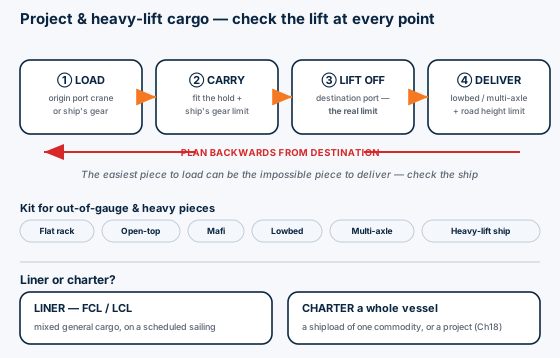
- The lifting capacity of both the ship’s gear and the destination port’s equipment must be checked — a piece that can be loaded may not be liftable at the other end.
- It may be worth waiting for a suitable vessel rather than taking an earlier, unsuitable one.
A modern factor NAFL highlights: ships increasingly lack their own heavy lifting gear and rely on well-equipped ports (it names Dubai’s port facilities) — so the port’s crane capacity becomes a routing constraint in its own right.
The project cargo a Gulf forwarder actually sees
In WorldZone’s markets (Chapter 29), project cargo clusters into a few recognisable types — worth knowing because each has its own handling signature:
- Transformers and power-generation units — very heavy, high-value, shock-sensitive; moved on multi-axle trailers and often needing engineered lift plans.
- Oilfield and offshore equipment — drilling and wellhead components, modules and skids for rigs and offshore facilities; frequently combined with dangerous goods (Chapter 21) and tight timing.
- Renewable-energy cargo — wind-turbine blades (extremely long out-of-gauge units that dominate the whole route planning) and solar panels (high-volume and fragile).
- Steel fabrication and structural components — beams, columns, fabricated sections for construction and infrastructure (Chapter 29).
Specialised equipment for awkward cargo
The container family still helps here — flat racks and open-top containers (Chapter 11) carry out-of-gauge and heavy pieces that won’t fit a standard box. Beyond containers, carriers offer flat platforms / “mafis” (skeleton trailers) for very heavy units within the port area, and ro-ro vessels (Chapter 15) for anything that can be rolled or driven aboard.
On the land legs, project cargo needs its own fleet of specialised road equipment — and the right trailer is as much a part of the plan as the right vessel:
- Flatbed trailers for standard heavy/long loads.
- Lowbed / low-loader trailers — a dropped deck to carry tall machinery (excavators, transformers) within road height limits.
- Hydraulic and multi-axle trailers — many axles that spread very heavy loads and steer, for the largest indivisible pieces; axles can be added to match the weight.
- Rigging and heavy-lift coordination — planning and supervising the actual lifts (cranes, gear, lift points) at each transfer, so a piece is liftable, not just loadable.
Chartering vs liner shipping
When a cargo is large and homogeneous enough, it stops making sense to book space on a scheduled (liner) service and becomes worth chartering a whole vessel.
Chartering is hiring a whole vessel (or its capacity) for a voyage or period, rather than buying space on a scheduled liner sailing. Large bulk quantities — ore, coal, grain, oil — and major project movements are typically chartered. Smaller, mixed general cargo goes as liner cargo (FCL/LCL on scheduled services).
NAFL lists the vessel types a large bulk cargo might require chartering — ore/bulk carriers, tankers (VLCC), reefer ships, ro-ro and combi vessels (covered in Chapter 12). The forwarder handling break-bulk must contact carriers’ agents to find which suitable vessels are available, and when. Chartering is a craft of its own — the charter types, the broker and fixture, and the commercial terms (freight, hire, laytime, demurrage) are covered in full in Chapter 18.
Break-bulk and project cargo remain specialist work, but the toolkit has grown: purpose-built heavy-lift / project carriers with very high-capacity onboard cranes are now a mature market segment, and modular/self-propelled transporters move enormous pieces on land. The principle NAFL teaches is unchanged — plan the whole route, end to end, including the lifting capacity at every point — but the equipment available to execute it is far more capable than in 2003.
Break Bulk & Project Shipments is one of WorldZone’s core services — and the one that most rewards careful planning. Unlike a routine FCL, a project move has no standard answer: every piece needs its dimensions, weight and lifting points checked against the vessel, the ports at both ends, and the inland route. The operator’s habit here is to plan backwards from the destination’s lifting and access constraints — because the easiest piece to load can be the impossible piece to deliver. This is where a forwarder genuinely earns the title “architect of transport.”
What to take from this chapter
- Break-bulk = cargo loaded piece-by-piece, not boxed or bulk — more handling, more care.
- Project / heavy-lift cargo must be planned at quoting, checking lifting capacity at every point — ship and both ports.
- Use flat racks, open-top, mafis, ro-ro for out-of-gauge and heavy pieces.
- Large homogeneous cargo → charter a vessel; mixed general cargo → liner (FCL/LCL).