
Part IV — Ocean Freight
Roll-on / Roll-off (RoRo)
Shipping built for things with wheels — cars, trucks, buses and heavy machinery driven straight onto the vessel over ramps, with no container and no crane.
Chapter 12 introduced the ro-ro vessel as a ship type. This chapter treats RoRo as what it is for WorldZone — a named service, and the right answer whenever the cargo has wheels. The idea is simple: instead of lifting cargo into a box, you drive it straight onto the ship over built-in ramps, and drive it off at the other end.
RoRo is the carriage of wheeled and self-propelled cargo on purpose-built vessels with internal decks and ramps, so units can be driven aboard under their own power (or towed on roll-trailers) rather than containerised and craned. The opposite — lifting boxes by crane — is Lo-Lo (lift-on/lift-off, Chapter 20).
What moves by RoRo
- Passenger vehicles — cars, SUVs, motorcycles, vans.
- Commercial vehicles — trucks, trailers, buses, even tankers.
- Construction & agricultural equipment — excavators, wheel loaders, cranes, tractors.
- Heavy machinery and oversized units too large or awkward for a container.
Why choose RoRo
- No container, no crane. Wheeled units load and discharge by driving — eliminating container stuffing and the lift onto/off a stack. That means less handling, lower damage risk and lower cost for the right cargo.
- Speed of turnaround. A RoRo vessel loads and discharges fast — units roll on and off continuously rather than being craned one box at a time.
- Fits the awkward. Anything self-propelled or trailer-mounted that won’t sit happily in a box is a natural RoRo candidate (the alternative being flat-rack/break-bulk, Chapter 14, when it can’t move on wheels at all).
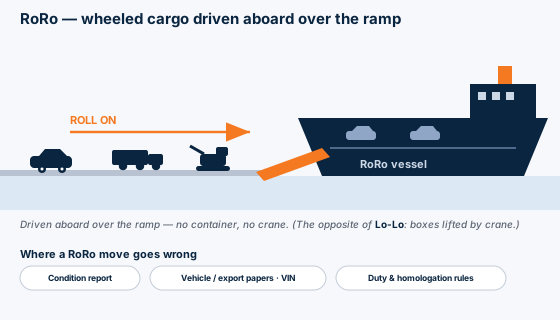
How a WorldZone RoRo move runs
The discipline is the same end-to-end chain as any shipment (Chapter 31), with vehicle-specific steps:
- Booking on a suitable RoRo sailing (ex Dubai/GCC to India and worldwide).
- Origin handling — delivering or driving the unit to the RoRo terminal; recording its condition (a vehicle condition report protects against later damage disputes).
- Loading — units driven aboard and lashed to the deck.
- Documentation — vehicles need their ownership/export papers in order (chassis/VIN details, export certificate, invoice); used-vehicle exports in particular are tightly controlled.
- Destination clearance and delivery — customs (vehicles often carry specific duty and homologation rules), then driven or trucked to the consignee.
RoRo is a genuine WorldZone service line, ex-Dubai/GCC to India and beyond, and the value is the same as everywhere else in this book: one accountable company runs the booking, the origin port handling, the sailing, and the clearance and delivery at destination — not a relay of strangers. When an enquiry is “I need to move a vehicle / a piece of plant on wheels,” the operator’s first thought should be RoRo, then the condition report and the vehicle paperwork, which is where these moves most often go wrong.
What to take from this chapter
- RoRo = wheeled/self-propelled cargo driven on and off over ramps — no container, no crane (the opposite of Lo-Lo).
- It carries vehicles, trucks, buses and mobile machinery, ex Dubai/GCC to India and worldwide.
- The wins are less handling, less damage and lower cost for the right cargo, plus fast turnaround.
- The risk points are the condition report and the vehicle/export documentation — get both right.