
Part IV — Ocean Freight
Dry Bulk Cargo
Loose, unpackaged commodities — grain, cement, fertiliser, ores — carried by the shipload in a bulk carrier, where vessel selection, stevedoring and cargo protection are the whole job.
Some cargo never sees a container or a package. It is poured, scooped or conveyed loose into the hold of a ship and carried by the shipload. That is dry bulk — and it is a WorldZone service in its own right, drawing on the bulk carrier from Chapter 12.
Dry bulk is a large volume of a single, unpackaged dry commodity carried loose in the hold of a bulk carrier. There is no unit, no box and no pallet — the cargo is the load, measured by weight, and the shipment is usually a whole or part vessel, not a liner slot.
What moves as dry bulk
- Agricultural / food commodities — grains, cereals, rice, sugar and similar.
- Construction materials — cement, clinker, gypsum and aggregates.
- Minerals and ores in bulk form.
- Fertilisers — urea, DAP and the like.
These are dense, low-value-per-tonne cargoes, so they are weight-charged (Chapter 3) and economics turn on moving the largest volume at the lowest cost per tonne — which is exactly why they move by the shipload and often by charter (Chapter 18).
What the job actually is
For dry bulk, the forwarder’s value is in the operation around the cargo, not paperwork alone:
- Vessel selection — securing suitable bulk-carrier space (or chartering a vessel) for the commodity and volume.
- Stevedoring — arranging the loading and discharge gangs and gear (grabs, conveyors, hoppers) at each port.
- Load / discharge logistics — sequencing the operation so the vessel loads and turns around efficiently (laytime matters — see demurrage, Chapter 18).
- Cargo protection — guarding against moisture, contamination and loss in handling and storage; a wetted or contaminated bulk cargo can be ruined or rejected.
- Documentation & customs at both the loading and discharge ports.
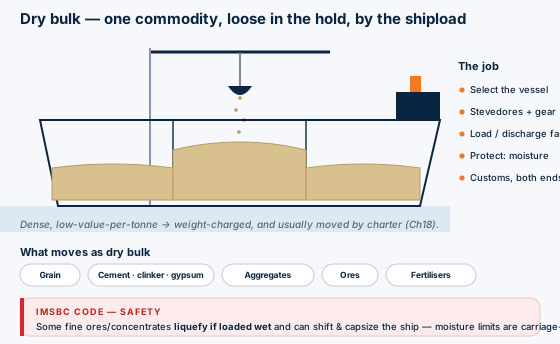
Some dry bulks are deceptively dangerous. Fine ores and certain concentrates can liquefy if loaded wet (shifting and capsizing the vessel), and some cargoes self-heat or emit gas. Modern carriage is governed by the IMSBC Code (International Maritime Solid Bulk Cargoes), which classifies bulk cargoes and sets carriage and moisture limits — the bulk-cargo equivalent of the IMDG discipline in Chapter 21.
Dry bulk sits at the heart of WorldZone’s construction and agricultural traffic (Chapter 29) — cement and aggregates inbound to Gulf building sites, fertiliser and grain on the regional trades. The operator’s job is the operation: the right vessel, clean and dry holds, competent stevedores, and a sharp eye on moisture and contamination. It frequently runs hand-in-hand with chartering (Chapter 18), because a shipload of one commodity is the textbook reason to take a whole vessel rather than book liner space.
What to take from this chapter
- Dry bulk = one unpackaged dry commodity, loose in a bulk carrier, by the shipload — weight-charged.
- It covers grain, cement/clinker/gypsum/aggregates, ores and fertilisers.
- The job is vessel selection, stevedoring, load/discharge logistics and protection from moisture/contamination — plus customs both ends.
- It pairs naturally with chartering (Chapter 18) and is governed for safety by the IMSBC Code.