
Part IV — Ocean Freight
Liquid Bulk Cargo
Moving liquids in volume — by ISO tank, flexitank or dedicated tanker — where the equipment choice, cleanliness and IMDG/ADR compliance are everything.
Liquids travel in their own way. A drum-by-drum shipment is just general cargo, but once the volume is large enough the liquid moves in bulk — and the central decision becomes which vessel for the liquid: an ISO tank, a flexitank, or a dedicated tanker. Choosing right is the whole skill.
Liquid bulk is the carriage of liquids in volume, by one of three methods: ISO tank containers, flexitanks, or dedicated tankers (Chapter 12). The forwarder matches the method to the product — its volume, value, hazard class and cleanliness needs — then manages cleanliness, compatibility and compliance.
The three ways to move a liquid in bulk
- ISO tank container — a stainless-steel tank built into a 20′ container frame (≈ 14,000–26,000 litres). Reusable, robust, the standard for hazardous and high-value liquids; handles like a container (Chapter 11) and stacks/ships on normal container vessels. Heatable/insulated versions exist for products that must stay warm or liquid.
- Flexitank — a large disposable bladder (≈ 16,000–24,000 litres) fitted inside a standard 20′ container, turning an ordinary box into a one-way liquid carrier. Cheap and one-way, ideal for non-hazardous food-grade and industrial liquids in bulk (e.g. edible oils, base oils, juices). Not for dangerous goods.
- Tanker — a dedicated vessel for very large parcels of liquid (crude, chemicals, oils) — the liquid-bulk equivalent of the dry-bulk shipload (Chapters 12, 18).
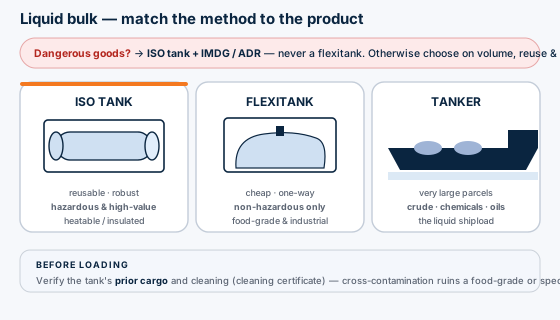
What moves as liquid bulk
- Chemicals — industrial and specialty, including hazardous grades (which force an ISO tank and IMDG/ADR compliance).
- Edible oils and food-grade liquids (often flexitank).
- Base and lubricant oils and industrial fluids.
What the job actually is
- Equipment selection — the core call: ISO tank vs flexitank vs tanker, matched to the product’s volume, value and hazard.
- Compliance — for hazardous grades, the correct IMDG / ADR documentation and the correct tank selection and approvals (Chapter 21). A hazardous liquid in the wrong equipment is a non-starter.
- Tank cleanliness & compatibility — verifying the tank’s previous cargo and cleaning so the new product is not contaminated (a “cleaning certificate” / prior-cargo check). Cross-contamination can ruin a food-grade or specialty-chemical load.
- Loading, sailing and destination clearance coordinated end to end.
Liquid bulk is a named WorldZone service and a real specialism, because the equipment decision is where money and risk live. The operator’s instinct on a liquid enquiry: first is it dangerous goods? (if yes → ISO tank + IMDG/ADR, never a flexitank); then food-grade or industrial, and what volume? (flexitank for a one-way non-haz parcel, ISO tank for reuse/hazard/heat, tanker for a very large parcel); then what was in the tank last, and is it clean and compatible? Get those three right and the rest is the standard chain (Chapter 31).
What to take from this chapter
- Liquid bulk moves by ISO tank, flexitank or tanker — matching the method to the product is the whole skill.
- ISO tank = reusable, robust, the choice for hazardous/high-value (and heatable); flexitank = cheap, one-way, non-hazardous food/industrial liquids; tanker = very large parcels.
- Hazardous grades demand IMDG/ADR compliance and the correct approved tank (Chapter 21).
- Tank cleanliness and product compatibility (prior-cargo check) prevent ruinous cross-contamination.