
Part VI — Specialised Cargo & Operations
Packing, Marking & Labelling
How goods are protected and identified in transit — the three P's of packaging, the main packaging types, container stowage and restraint, and the standard shipping marks.
Cargo that is badly packed or badly marked arrives damaged, delayed or in the wrong place. NAFL treats this as core forwarder knowledge: even though the shipper usually packs, the forwarder advises on packaging and is increasingly involved in packing goods into containers — and is often liable for damage caused by a bad stow. Two definitions to start, because the words are used precisely:
- Packaging (noun): the materials and systems used to wrap, protect and present goods during and after transit.
- Packing (verb): the systems and procedures used to load and secure cargoes in transit (e.g. stuffing a container).
The three P’s of packaging
Packaging exists to Protect, Preserve and Present. It must protect against loss, damage and pilferage; preserve the contents against moisture, temperature, light, gases, infestation and contamination; and present the goods (size, shape, branding) to the market. It must also meet international standards and the laws of the destination/transit countries.
Guidelines for choosing packaging
NAFL gives a long practical checklist; the essentials a forwarder advises on:
- Goods should be well stowed and secured within the package, voids cushioned and braced (battens, dunnage); a full, tight package is a stronger package.
- Unitise small packages (palletise) to cut theft and handling stress — a forklift loads 12 two-tonne pallets faster than a gang moves cartons.
- Mark packages with the number of layers they can be stacked under (“overstow”).
- Check destination/transit regulations on packing materials (e.g. untreated wood barred from Australia, bark-bearing wood from the USA).
- Don’t re-use old cartons/cases — they collapse and invite confusion and pilferage.
- Match package size to the product to save freight; don’t pack different freight-rated goods together (the carrier may rate the whole package at the highest rate).
- Provide waterproof wrapping/lining for cargo exposed to weather or outdoor customs areas.
- Avoid over-packaging — it wastes carrying capacity, especially in air freight.
The main packaging types
NAFL catalogues the standard types — a forwarder should know which suits what:
- Bagged cargo — robust commodities (grain, sugar, fertiliser, coffee); bags hold but don’t protect.
- Fibreboard boxes/cartons — cheap, widely used; fine for container cargo if not fragile.
- Wooden cases — strong walls, support superimposed loads; for heat/damp-sensitive or conventionally handled goods (plywood increasingly used).
- Wooden crates — skeletal; for resilient contents or large machinery.
- Bales — hessian-wrapped, compressible goods; vulnerable to hooks/pilferage.
- Drums, barrels, casks — liquids and powders (chemicals, oil, paints).
- Shrink-wrapping — bags interlocked on a pallet, polythene heat-sealed into one unit load.
- Lift vans — purpose-built unit loads for household goods.
- Corrosion preservation — machinery vacuum-sealed/greased with desiccant against humidity.
- Special cargo — bulk (no packing, needs the right vessel/gear), high-value (gold, jewellery — mostly by air, direct delivery), perishables/reefer, live animals (cages, feed, quarantine), and dangerous goods (Chapter 21).
Stowing and securing cargo in containers
The maxim from Chapter 11, expanded: a correct, immovable stow and even weight distribution. Either stow tight, or restrain. NAFL’s methods of securing:
- Shoring — bars/struts/spars in the voids, pressing cargo against the walls or other cargo.
- Lashing — ropes, wire, chains, strapping or netting tensioned to anchor points.
- Wedging — wooden pieces, pads, inflatable dunnage bags filling voids.
- Locking — building cargo into an interlocking “brick wall.”
Practical rules: use the built-in securing points (respect their limits); timber dunnage must be dry and quarantine-compliant; never nail into a reefer floor; heavy items and liquids go bottom, light and dry on top; leave any unavoidable gap down the centre line, not at the sides; and stop the “face” of the stow from collapsing against the doors (so it doesn’t fall out when opened at destination or for customs).
Load factors
Spread weight across the container floor: over the full width, and lengthwise over the cross members (roughly one tonne per two floor members at 1-ft centres). Distribute as evenly as possible — a tightly stowed box in Singapore must still be unloadable in Dubai.
Shipping marks and labelling
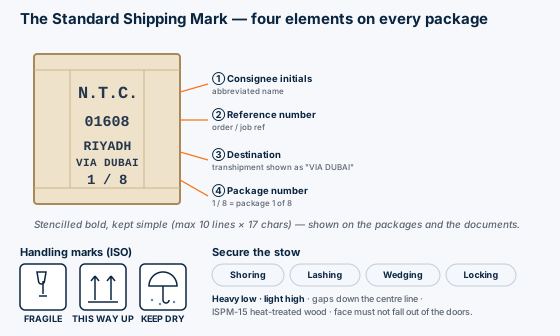
A standard shipping mark, shown on packages and documents, has four elements in order:
- Initials / abbreviated name of the consignee (e.g.
N.T.C.) - Reference number (e.g.
01608) - Destination (e.g.
RIYADH— with transhipment shown asRIYADH VIA DUBAI) - Package number (e.g.
1/8= package 1 of 8)
Marks identify cargo for everyone handling it and let cargo be checked against documents. They should be stencilled in bold on the sides and top, kept simple (no clutter that causes error), and standardised: NAFL’s “simpler shipping marks” rules cap a mark at 10 lines × 17 characters, using only typeable characters, no geometric shapes, Roman alphabet at minimum. Separate from the shipping mark are information marks (gross weight, country of origin) and cargo handling marks — the internationally agreed ISO handling symbols (fragile, this-way-up, keep-dry) and the DG hazard labels from Chapter 21, printed in the destination language.
The packaging types, the three P’s and the stowage rules are timeless and need no update. Two modernisations: wood packaging now must usually be heat-treated and stamped to ISPM 15 (the formal version of NAFL’s “treated wood” note) to cross most borders; and shipping marks are increasingly supplemented or replaced by bar codes / QR codes and RFID for automated tracking (Chapter 25) — though the four-element human-readable mark remains the fallback everywhere.
Packing advice is part of the documentation/forwarding service WorldZone sells, and the container stow is often the forwarder’s own liability — a point that matters directly on consolidated boxes (Chapter 13), where mixed shippers’ cargo must be compatible, evenly weighted, and stowed so it survives the trip and clears customs without collapsing out of the doors. The everyday habits: insist on ISPM-15 wood, the four-element mark on every package, heavy-low / light-high, and compatible cargo only in a shared box.
What to take from this chapter
- Packaging = protect/preserve/present; packing = load/secure. Know the difference.
- Match the packaging type to the cargo; don’t re-use cases; waterproof what’s exposed.
- Container stows must be immovable + evenly distributed; secure by shoring / lashing / wedging / locking; heavy low.
- The Standard Shipping Mark = initials · reference · destination · package number; keep marks simple; use ISO handling symbols + DG labels.