
Part VI — Specialised Cargo & Operations
Warehousing
Where cargo waits and flows — the types of warehouse (including bonded), the public-vs-private decision, and the core warehousing functions of storage and movement.
Warehousing is more than storage — for a modern forwarder it is about flow: receiving, holding briefly, and dispatching cargo efficiently as part of the supply chain. NAFL frames the warehouse’s two basic functions as storage and movement, and a good operation emphasises movement — fast, accurate throughput — over static holding.
Types of warehouse
NAFL lists six types; a forwarder should know which suits which cargo:
- General merchandise warehouse — the most common; stores almost any product for manufacturers, distributors and customers.
- Refrigerated / cold storage (“cool stores”) — temperature-controlled, for perishables (fruit, vegetables, frozen food) and some pharmaceuticals/furs. NAFL notes Dubai uses cool stores even for electronics and chocolate because of the extreme heat.
- Bonded warehouse — see below; the one with special customs significance.
- Household goods warehouse — personal effects, often longer-term; with open-floor, private-room/vault, or container storage options.
- Special commodity warehouse — single agricultural products (grain, wool, cotton), with product-specific services (cleaning grain, compressing cotton) and interchangeable bulk storage by grade.
- Bulk storage warehouse — tank storage of liquids, open/sheltered storage of dry bulk (coal, sand, chemicals); may fill drums or mix compounds.
The bonded warehouse — why it matters
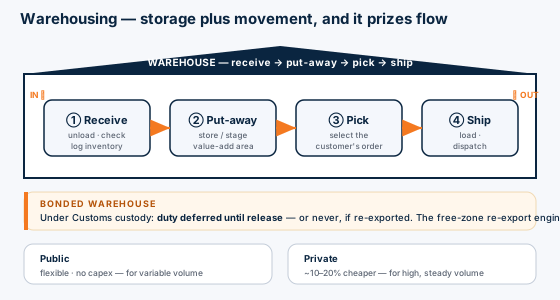
A bonded warehouse places its premises under the custody of Customs. Imported goods (e.g. tobacco, alcohol, or any dutiable cargo) can be stored there while the government retains control, and import duty/tax is not payable until the goods are released into the local market. The advantage is cash flow — the importer defers duty until the goods are actually sold.
This is the same principle that powers the UAE’s free zones (Chapter 10): goods sit duty-suspended and can even be re-exported without ever paying local duty. For a re-export hub, the bonded/free-zone warehouse is foundational infrastructure, not a niche.
The re-export trader — the archetypal bonded customer
The bonded warehouse is not just a place dutiable goods happen to sit — for a whole class of customer it is the business. Picture a trader who imports cargo from the source country where it is produced (China, India and the like), holds it in the UAE duty-suspended, and re-exports it to surrounding countries where they have found buyers — the GCC, Africa, the wider region. Importing and re-exporting is not a leftover from unsold stock; it is their core business, and the UAE is chosen precisely because its free-zone/bonded status lets goods flow through without local duty ever attaching.
Cargo held for such a trader leaves by one of two doors, and the door decides the duty:
- Re-export — the goods move on to a buyer in another country. They never enter the local market, so no local duty is due (the duty deposit is refunded — Chapter 20).
- Local sale — the goods are cleared into the UAE market for a domestic buyer; duty becomes payable at that point, and the forwarder often handles the last-mile delivery to the buyer.
A single consignment can split across both exits — part re-exported to a regional buyer, part cleared and delivered locally — which is why the forwarder’s job is not only storage but customs handling plus onward delivery on whichever door each carton takes.
Public vs private warehousing
A recurring distribution decision NAFL works through:
| Public warehouse | Private warehouse (owned/leased) | |
|---|---|---|
| Initial investment | None | Large (facility, equipment, staff) |
| Operating cost | Higher (includes provider’s profit + selling/advertising) | ~10–20% lower if volume is sufficient and consistent |
| Control | Less direct | Direct over personnel and procedures |
| Flexibility / risk | Flexible, low risk, scalable | Less flexible; risk of obsolescence if demand/technology shifts |
| Best for | Variable/seasonal volume, new markets | High, steady volume in established markets |
In practice most large operators use a combination — private warehouses for steady core volume, public warehouses for peak or low-volume markets.
The functions of warehousing
NAFL breaks movement into four handling activities, then expands to the full operational set:
- Receiving — unload, update inventory records, inspect for damage, verify count against orders.
- Transfer / put-away — move goods into storage, or to value-added areas (consolidation), or to the loading dock.
- Customer order selection (picking) — regroup goods into the assortments customers ordered.
- Shipping — load assembled orders, adjust inventory, check outbound orders.
Around these sit inventory control, purchasing, order entry, redistribution, replenishment, checking, packing & marking, and staging/consolidation — plus the clerical work that ties them together. Two storage modes: temporary (just enough for turnover — emphasises flow) and permanent (excess held for seasonal/erratic demand).
Layout, design and handling systems
A good layout increases output, improves flow, cuts cost, improves service and working conditions. Principles: calculate space needs carefully; use high/vertical storage; size aisles correctly (too narrow restricts flow, too wide wastes space); use space-utilisation standards. Handling runs from standard (the forklift — the basic tool of almost every warehouse — plus hand trucks, cranes) to automated (computer-controlled, up to AS/RS — Automated Storage and Retrieval Systems), which only became feasible with the IT systems of Chapter 25.
NAFL’s types and functions still hold, but the field has moved from storage to fulfilment. Modern warehouses run WMS (Warehouse Management Systems) with barcode/RFID tracking, AS/RS and robotics, and increasingly serve e-commerce pick-and-pack at a scale unimagined in 2003. The bonded/free-zone concept NAFL describes has become a core pillar of the UAE economy. The vocabulary of 3PL/4PL logistics (Chapter 27) grew out of exactly this warehousing-plus-movement function.
Warehousing connects WorldZone’s freight services to Supply Chain Management (Chapter 27) — and the bonded/free-zone warehouse is central to the UAE re-export model the whole network runs on. WorldZone offers bonded and commercial warehouse facilities across the UAE and GCC, with temperature-controlled storage for cold-chain cargo (pharma, perishable FMCG (fast-moving consumer goods) — Chapter 29) and real-time inventory reporting so a customer can see stock levels and movements live. For a customer, the value is duty deferral plus a staging point between the sea/air leg and final inland delivery (Chapter 24). The operator’s judgement mirrors NAFL’s public-vs-private table: use flexible third-party/free-zone space for variable cargo, and understand that for a re-export customer the bonded status — not the shelving — is the point.
What to take from this chapter
- Warehousing is storage + movement — modern operations prize flow.
- Know the six types — and especially the bonded warehouse, which defers duty and underpins re-export/free zones.
- Public vs private is a volume/control/risk trade-off — most operators combine both.
- Core functions: receive → put-away → pick → ship, supported by inventory control and (increasingly) WMS + automation.