
Part VI — Specialised Cargo & Operations
Inland & Overland Haulage
The first and last legs of almost every shipment — moving cargo by road and rail between port/airport and the customer's door, and the GCC overland network.
Almost no shipment begins or ends at a port. Between the quay or the airport and the customer’s premises lies the inland leg — by road or rail — and it is where door-to-door service is won or lost. NAFL treats inland transport throughout the procedures and multimodal sections rather than as a standalone chapter; this chapter gathers it together, because for WorldZone it is one of the core services and a daily reality.
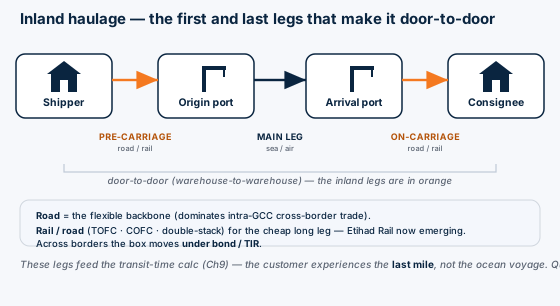
Pre-carriage and on-carriage
- Pre-carriage — the inland leg from the shipper’s premises to the port/airport of departure (collection, export haulage).
- On-carriage — the inland leg from the arrival port/airport to the consignee’s premises (delivery, import haulage).
Together with the main international leg, these complete the door-to-door (warehouse-to-warehouse) movement that customers increasingly expect.
These legs feed directly into the transit-time calculations of Chapter 9 — recall NAFL builds total transit from collection + export + main leg + import + delivery, never the sea/air leg alone.
Road haulage
Road is the most flexible inland mode — it reaches any door, with no fixed terminals. NAFL’s road notes (and the broader trade):
- Drayage / trucking moves containers between port and inland point on a chassis; the box is not opened (an FCL stays sealed door-to-door).
- For LCL, cargo is trucked to/from the Container Freight Station for consolidation/de-consolidation (Chapter 13).
- Road dominates intra-GCC trade — there is no integrated regional rail network for general cargo, so cross-border trucking is the backbone (e.g. UAE ↔ Oman/Saudi/Qatar).
- A road price quoted “door-to-door” must state clearly that it covers transport only — customs duties, taxes, clearance and storage are for the goods, and rate/exchange fluctuations too (NAFL’s standing rule against ambiguity).
Rail and rail/road multimodal
Where rail networks exist, the rail/road combination (Chapter 20) carries the long inland leg cheaply and quickly, with trucks handling only first and last miles — TOFC (trailer on flat car) and COFC (container on flat car), and double-stack trains where bridge heights allow. Rail is energy-efficient and runs day and night, but is fixed to its network, so it almost always pairs with road for the final delivery.
Cross-border and bonded movement
Inland legs that cross national borders raise customs questions NAFL flags directly:
- Cargo may move under customs bond between ports/free zones and inland points without paying duty at the border — but only where the customs regime allows it (Chapter 10). Where it doesn’t, a container must be emptied and cleared at the arrival port, eroding the door-to-door advantage for inland consignees.
- The TIR carnet (Chapter 10) is the classic instrument enabling sealed road transit across multiple countries under a single customs document.
The road backbone of GCC trade is unchanged, but two developments matter: the long-planned GCC Railway network (and the UAE’s own Etihad Rail, now operational for freight) is beginning to add a genuine regional rail option for the first time, shifting some long-haul cargo off the road; and GPS/telematics fleet tracking (Chapter 25) has turned the inland leg from a blind spot into a visible, monitored part of the journey — exactly the kind of real-time control NAFL anticipated in its IT chapter.
Inland / Overland Haulage is one of WorldZone’s core services, and the related WayTrans land-transport operation sits in the same group — overland GCC logistics is a real business line, not an afterthought. For an operator, the inland leg is where a “door-to-door” promise is actually delivered: arranging pre-carriage collection, the bonded or cleared movement, and final on-carriage delivery. The discipline from Chapter 9 applies — quote the inland leg explicitly, state what’s included, and build it into the transit time, because the customer experiences the last mile, not the ocean voyage.
What to take from this chapter
- Pre-carriage (door→port) and on-carriage (port→door) complete the door-to-door movement and feed the transit-time calculation.
- Road is the flexible backbone — especially intra-GCC, where it dominates cross-border trade.
- Rail/road (TOFC/COFC, double-stack) carries the cheap long inland leg where networks exist — now emerging in the GCC via Etihad Rail.
- Cross-border legs may move under bond (or TIR carnet); always quote the inland leg explicitly and include it in transit time.