
Part VII — The Modern Industry
Digitalisation & Technology
How freight forwarding went digital — from NAFL's EDI to today's e-documents, APIs, TMS, customs single-windows and real-time visibility.
This chapter modernises the part of NAFL that has dated the most. Its 2003 “Introduction to Information Technology” was forward-looking for its time — it correctly identified that “the data that describes, locates and values a cargo is now equally as important as the cargo itself.” That insight is truer than ever; the tools have simply leapt ahead. We keep NAFL’s principle and replace its 2003 toolkit with today’s.
NAFL’s enduring principle
The 2003 notes framed logistics as the integration of two parallel flows — the physical flow of goods and the information flow that controls it — and argued that good information enables good decisions while bad information does the opposite. That remains the foundation. Everything below is about making the information flow faster, more accurate and more connected.
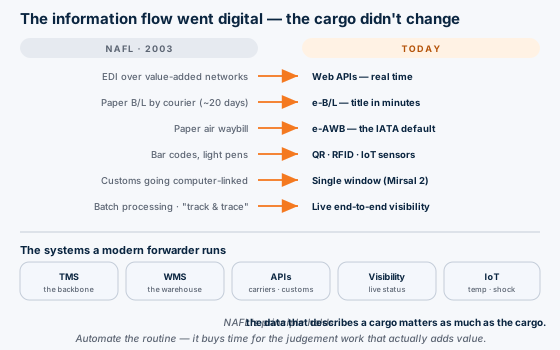
What has replaced NAFL’s 2003 toolkit
| NAFL (2003) | Today |
|---|---|
| EDI over value-added networks (TRADANET, EDIFACT, SWIFT) | EDI persists, but web APIs now connect systems in real time |
| Paper B/L moving by courier (~20 days) | Electronic B/L (e-B/L) — title transfers in minutes |
| Paper AWB | e-AWB, now the IATA default |
| Bar codes, light pens | Bar codes + QR codes, RFID, IoT sensors |
| Customs shifting from paper to computer links | Customs single-window portals (UAE: Dubai Trade / Mirsal 2) |
| Batch vs real-time processing | Cloud, real-time by default; mobile everywhere |
| ”Track and trace” as an emerging idea | End-to-end visibility platforms with live GPS |
The modern digital document chain
- e-B/L (electronic bill of lading) — the biggest single change. The paper B/L’s slow physical journey between shipper, banks and consignee (which NAFL noted could leave cargo stranded at the port awaiting documents) is replaced by digital title transfer through platforms governed by legal frameworks like the MLETR and the UK’s Electronic Trade Documents Act. Initiatives such as Bolero, essDOCS/WaveBL and carrier platforms make it routine.
- e-AWB — the electronic air waybill is now IATA’s default, removing paper from air freight.
- Digital customs — declarations filed through single-window systems; in the UAE, Dubai Trade / Mirsal 2 integrate customs, ports and free zones in one electronic interface (Chapter 10).
The systems a modern forwarder runs
- TMS (Transport Management System) — plans, books, rates, documents and tracks shipments; the forwarder’s operational backbone.
- WMS (Warehouse Management System) — runs the warehouse: receiving, put-away, picking, dispatch (Chapter 23).
- API integration — direct system-to-system links to carriers, customs, ports and customers for instant rates, bookings and status — the real-time successor to batch EDI.
- Visibility / track-and-trace platforms — aggregate GPS, carrier and IoT data to show where every shipment is, in real time, to the customer.
- IoT sensors — track location, temperature, shock and humidity inside reefer and high-value containers.
Why it matters to the forwarder
Digitalisation is now a precondition of doing business, exactly as NAFL observed EDI was becoming. Customers expect instant quotes, online booking and live tracking; carriers and customs increasingly accept only electronic submissions; and the margin pressure in forwarding makes manual, paper-based processing uncompetitive. The forwarder who automates the routine wins time for the judgement work — routing, problem-solving, advice — that actually adds value.
WorldZone already lives part of this future: its internal AI system (built by VoltusWave) and its WhatsApp automation show the direction of travel. The practical priorities for a network like WorldZone: API/portal connections to its carriers for live rates and bookings; e-B/L and e-AWB adoption to kill the document-delay problem NAFL described; single-window customs filing across all seven countries; and a customer-facing visibility layer so a shipper can self-serve status. Each removes a manual step and a source of error — and frees operators for the advisory role that retains customers. (Note for Nisarg: this is exactly where an Arise-AI-style agent layer could plug in — flagged for the cross-project review.)
What to take from this chapter
- NAFL’s principle holds: the information flow is as important as the cargo; good data = good decisions.
- The toolkit jumped — EDI → APIs, paper B/L → e-B/L, bar codes → RFID/IoT, computer customs → single-window.
- A modern forwarder runs a TMS + WMS, integrates by API, and offers real-time visibility.
- Digital capability is now a precondition of competing, not an extra.