
Part VII — The Modern Industry
Market Forces & Disruptions
The forces that move rates and reshape routes since 2003 — carrier alliances, IMO 2020, the COVID container crunch, and the Red Sea/Suez crisis.
NAFL taught the freight market of 2003 — “conference” lines, “flags of convenience,” a world of “more carrying capacity than cargo.” That market has been transformed. A credible forwarder today must understand the forces that now move rates and rewrite routings overnight, because they directly affect every quote (Chapter 5) and every transit time (Chapter 9). This chapter is entirely new — it is the context the 2003 book could not contain.
From conferences to alliances
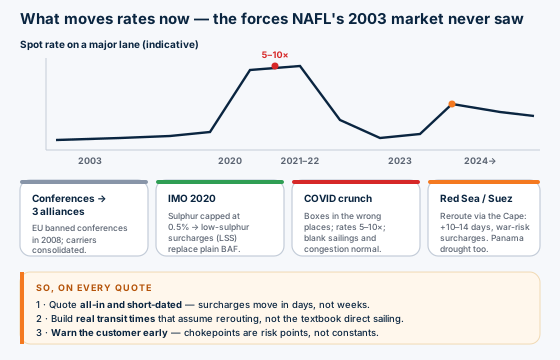
NAFL describes shipping conferences (carriers agreeing common, reduced rates) and independent outsiders under flags of convenience. The EU abolished liner conferences in 2008. The market then consolidated dramatically — through mega-mergers and the collapse of carriers like Hanjin (2016) — into a handful of giants and three global alliances:
- 2M (Maersk + MSC — now winding down; MSC going it alone as the largest carrier)
- Ocean Alliance (CMA CGM, COSCO, Evergreen)
- THE Alliance (Hapag-Lloyd, ONE, Yang Ming, HMM)
These alliances share vessels and networks, which concentrates capacity and gives carriers far more influence over rates than the fragmented market NAFL knew.
IMO 2020 — the fuel rule that reshaped surcharges
IMO 2020 is the International Maritime Organization regulation, effective 1 January 2020, capping the sulphur content of marine fuel at 0.5% (down from 3.5%). Ships must burn more expensive low-sulphur fuel, fit exhaust scrubbers, or switch to alternative fuels (LNG). The cost flows straight into freight via Low Sulphur Surcharges (LSS/LSF) — which is why NAFL’s simple BAF (Chapter 5) has been supplemented or replaced by low-sulphur fuel charges.
This is the single most important regulatory change to ocean economics since the NAFL era, and it sits on top of a broader decarbonisation push (methanol- and ammonia-ready ships, an EU emissions-trading cost on shipping from 2024) that will keep pushing fuel-linked surcharges upward.
The COVID container crunch (2020–2022)
The pandemic produced the most violent freight-market dislocation in modern history — essential for a forwarder to understand because its lessons still shape behaviour:
- A demand whiplash plus port congestion stranded containers in the wrong places, creating a global equipment shortage.
- Spot rates on major lanes spiked 5–10×; a route that cost ~US$1,500 hit US$15,000+.
- Blank sailings (carriers cancelling scheduled departures to manage capacity) and port congestion surcharges became routine.
- It permanently raised awareness that the “overcapacity” world NAFL described can flip to acute scarcity — and that quote validity (Chapter 5) can be days, not weeks.
The Red Sea / Suez crisis (2023–onward)
The chokepoint risk from Chapter 1, made real:
- From late 2023, attacks on shipping in the Red Sea forced most carriers to abandon the Suez Canal and reroute around the Cape of Good Hope.
- This added 10–14 days and thousands of dollars per container to Asia–Europe and Asia–Mediterranean transits, and reintroduced war-risk surcharges (Chapter 5).
- Combined with a 2023–24 drought cutting Panama Canal transits, it showed how fragile the world’s chokepoints are — and why a forwarder treats them as risk points, not constants.
What this means for the forwarder
The throughline from NAFL holds: the forwarder must “keep abreast of what is happening in their world.” In 2003 that meant knowing about port strikes and congestion; today it means tracking alliance capacity, fuel-rule surcharges, and live geopolitical disruption. The practical consequences:
- Quote all-in and short-dated — surcharges (LSS, war risk, congestion, peak season) move fast.
- Build realistic transit times that account for rerouting, not the textbook direct sailing.
- Advise customers proactively when disruption is coming — the advisory role NAFL prized is more valuable than ever in a volatile market.
For WorldZone’s India ↔ GCC ↔ Europe lanes, these forces are not abstract: Red Sea rerouting directly lengthens GCC–Europe transits and re-prices them; IMO 2020 / LSS is a line item on quotes; and alliance capacity decisions determine space and rate on the major corridors. The operator’s edge is exactly NAFL’s advice modernised — stay informed, quote short-dated and all-in, and warn customers early. This is also where a market-watch agent (a Tech-Radar / freight-market monitor) would earn its keep — flagged for the cross-project review.
What to take from this chapter
- Conferences are gone; the market is consolidated into a few mega-carriers and three alliances controlling capacity and rates.
- IMO 2020 (0.5% sulphur) drives low-sulphur surcharges; decarbonisation will keep fuel costs rising.
- The COVID crunch showed rates can spike 5–10× and validity can be days; blank sailings and congestion are now normal tools.
- The Red Sea/Suez crisis proves chokepoints are risk points — build rerouting into transit and price.